Sailboats Fair and fine: read olderposts first




 Wolftrap Drawings showing both rigs. Top picture is Schooner Wolftrap Sailing
Well we hung around about six weeks and I was offered work and took some of it. A little income makes all the difference. We visited friends and family and in general had a good time. I did some work on the boat that we had planed to do in Fort Lauderdale. I was feeling pretty good about the whole thing though I felt sorry for my wife. All this time Georgene was feeling down. She had a broken arm we had sold our nearly new home and moved on a boat that she couldn't stand up in and September was steady moving on. We were starting to have chilly nights and we couldn't drink the marina water.
About that time my new video camera broke down and we had to send it to Canon to have it fixed. I tried to talk them into lending me one until mine was fixed and they didn't show any interest. I told them what we were doing and offered to buy another one at a price reduced enough that I could sell it and not get hurt to bad. Again they weren't interested. It would be six to eight weeks before we could expect to get it back.
We went back to see Georgene's doctor and they thought we should wait three months while she took therapy. We decided to go in two weeks. They wanted her to sign a release and told us she would never get full use of her arm without professional help with the therapy. She still had some time to wear a sling so we had time to think about it.
This time there were no offers to throw a party . I guess friends and relatives were sick of us and wanted us to go on an get out of town.
The day before we were were to leave to go up the bay we were feeling a little nervouse about one of us breaking something so we didn't do any thing even remotely dangerous.
We moved Wolftrap out to the face dock at the end of the pier. I don't think we slept much that night. We probably would have been as well off sailing up the bay all night. Some time late we went to sleep and it got pretty cool the temperature dropped to the mid thirties and a pretty good layer of fog moved in. About four A.M. We were jolted awake. The work boats were on their way out and the first one rolled us against the dock. We had fenders out they are never exactly right somehow.
I jumped out of bed and said, “Common George lets get going.”
She raised up sleepily and said, “It's dark and we haven't had any coffee or breakfast,”
“Well we can get started and you can make breakfast under way,” I pleaded.
“No, I want my breakfast and I want to go wash up and brush my teeth,” she answered with a fair amount of firmness so thats what we did.
I stewed the whole time and didn't brush my teeth. Now you know that gets'em every time. I felt like I was even.
Finally the sky was getting light but the fog wasn't. There was a breeze holding against the dock but not strong. I went over a piling with a dock line and made it to my forward port cleat. Put the engine in forward and with just a little power she began pulling the stern out. The plow anchor mounted on the Bowsprit skidded across the top of the dock and I let go the dock line and pulled it to me I put her in reverse Wolftrap started backing away. I want to say right here that Wolftrap steered better than any sailboat I have ever owned. She had a balanced rudder with part of the rudder forward of the rudder post. With the engine running in reverse there was none of that thing of her backing to port. She went where you aimed her forward or reverse. I pushed the tiller to starboard and she backed to port and lined up with the channel. We headed out at about three knots through the fog. We could see from one buoy to the next so it was a piece of cake. We cleared the end of the channel and headed outto the channel of the York River. We were aiming for Buoy 22 which would be coming into view if the course I had laid into my Loran was correct. I hoisted the main and trimmed her and she started pulling right away next the forsail was hoisted and finally the jib and we killed the engine. Near silence ensued with only a gental swish, swish, of her bow gliding through small waves and then we could her the bell on buoy 22 . With a hot cup of coffee in the cold damp air and a feeling that God loves the world, we watched the sun sneak through the clearing fog.
The machine shop was sold in the summer 1986 and we put our house up for sale. It sold quick. I probably should have asked more for it?? In September we, moved aboard and was challenged by a hurricane. We were expecting about 100 mile per hour winds. We anchored out in Sarah's creek. With a CQR plow, two Danforths and a Herrshoff yachtsman with Woftrap in the center. I had almost no concern that we would drag anchor at least not more than fifty feet. The storm took a different course and we had about 50 knots of wind. We had spent the night aboard and were really happy that the worst of it missed us. It was really a pretty safe thing to do. We were up in the back end of the creak in a few feet of water. We were nearly surrounded by tall marsh grass and in the worst case we might wind up in someones bean field. The other boats were farther out in the creek and pretty much out of our way. Of course there was always the worry that one of them would drag anchor and hit us. I think that all our boats were in less danger than being tied to the docks with a couple hundred other boats all pulling snatching jerking at the pier and all In danger of climbing on top the piers. In a couple days we moved down to the old Buoy 22 Marina down in Guinea there in Gloucester Va. We had kept a boat there in the late 1960's . We loved the place it was almost all work boats ,water men and a few scraggly looking live aboards. Most of these guys worked at the marina or with crabbers or pound fishermen. Every body wanted to put us to work. we declined. We were busy running back and forth buying groceries and supplies. We ran around telling friends goodbye and all that usual kind of stuff They all wanted to give us a going away party and we wanted none of that. Ten years before we left for Bermuda after a huge going away party and about eight days later had to come sneaking back to the dock with a half wrecked boat. But thats another story. We scratched items off of lists as we shopped and added more. A lot of that was silliness as we were going down the waterway and would have ample opportunity to buy supplies. The water at the marina tasted like river bottom mud so we hauled jugs of water in the car from up on the highway. We only had about 30 gallons of water with the idea we would get all we wanted on the way.
We spent time at the Laundromat , the drugstore stocking up on our medicines and all manner of first aid items. We had been talking about how nice it would be to have one of those new 8mm video cameras. We had shopped around looking at them. I had found one I liked. It was a lot of money. Finally we decided to go look again. That afternoon we lost our minds and paid $1600.00 for a video camera. We had a little portable TV set stuffed up in the bow so we could watch our movies. The camera and the television set both would work on 12 volts DC and that was wonderful.
It was the day be for we were ready to leave. Georgene and I headed for the showers I got back to the boat first and set in the cockpit looking again for the one thousandth time at the waterway charts. Georgen came down the dock carrying he bag of toilet items, damp towels and cloths she had changed out of. There was a line across the finger pier from the stern of the boat in the next slip. IT hung down about three inches off the finger pier. Georgene stepped out onto the finger and the rope caught between her toes and the sole of her open towed candle. She started falling forward. I was standing on the boat seat pulling the boat over for her to get aboard. I jumped over to the finger pier to grab her and she fell forward and I landed partially on top of her. She went off the side of the pier grabbing the topside of the boat. She fell in hanging on to the boat. She came up blowing water and laughing and said, That must have been the funnest thing to watch ever. To bad there was nobody here to see it it. My Golly my shoulder hurts. I helped her out of the water. When on the dock went from laughing to crying. I asked, “Can you raise your arm.” I dreaded the answer. “No,” she said with a knowing look We tied her arm up and I helped her put on dry cloths and we went to the doctor. It was broken alright so we put off leaving for while.
I decided I would take Woftrap and go sailing. For sailing in the Bahamas and farther south I felt that the cat yawl rig with it's 500 square foot main was unhandy for sailing the Bahamian winter northers. I wanted the rig broken up into smaller parts. That my aging self and wife could handle. See I thought I was getting old. Boy what a waste of good muscle and sinue that was.
We began building a new rig using what spars we could, from the cat yawl rig. Bob, David and I sat up late nights in my office and drew up a rig using Mr. Bolger's same center of effort. The main mast was shortened and stepped on deck just forward of the main hatch with shrouds. The forward mast partners were made smaller for a 4' dia. foremast that mast when stepped was shorter than the 35 ft main mast and was stayed.
To keep the center of effort in the same place we added two feet to the bow sprite and put side stays on it and a bob stay so the jib stay could be kept tight. The tops of the masts were stayed together. The mains stays were somewhat back so they would to some degree act as back stays. The length of the main boom was determined by how far I could reach standing on a cockpit seat and leaning out over the transom to adjust the out haul. We started off drawing a gaff main and gaff fore sail.
To get her to balance the bow sprite would have had to had to have been several feet longer. It was already 6ft long and would have gone to 9 feet. A bit much I thought. As a result we changed the main to a Bermuda rig, and a gaff foresail The top of the main mast was fitted for a sheet to the foresail gaff So that when trimming sails the yard could be trimmed in so that she had a good shape at the top and was pulling good. The the fore sail boom was sheeted in until it was pulling. There was a big advantage in this type of rig. The foresail controlled by two sheets could be pulling top and bottom and not back wind the main going to windward. With a rig like this she would and did sail to windward like a banshee. There was another halyard on the forward side of the main mast and that was for the flat spinnaker that had been used forward when Woftrap was a cat yawl. We used the flat spinnaker like a Genoa buy attaching the luff to the deck behind the foremast. On some occasions we used the old spinnaker pole to set the luff of the sail to windward when reaching and running.
We also had a spinnaker and Genoa that we only set a few times with a large crew on board. It was unbelievable and scary as hell!! I thought we were going to sail her right under and would have I believe if the wind had picked up. Still she was not as weatherly as she could have been.
She had a clubfooted jib that had to be hauled in tight to get the whole sail to pull. That caused the lower portion to back wind the foresail. Had there been a sprite it could have been sailed with the sail out just as far as the foresail and their would have been no back winding any of the sails. She would then sail to windward with most sloops even though her sails were a low aspect ratio. The difference being that all three sails would have 100% of all all there canvas pulling as compared to about 80% in the Bermuda rig. It absolutely amazes me that sloop sailors keep saying that the foresail on a ketch or a schooner back winds the aft sail so they are slower to windward. With that kind of thinking all boats would be faster if they were cat boats. I never see sloop sailors take their jib down when they sail to windward. The sail that is forward doesn't have to back wind the sail behind it unless you want it to.
Off the wind is where the schooner comes into its own, where it is faster than a sloop and when you add on a staysail or golly wobbler speeds pick up at least a knot no matter what speed you are sailing at.. The staysail is over the cockpit and is easily hoisted and lowered by one person. Now the speed is limited by how far you want to drive the bow down in the water and how much you you want to lift the stern out and will you be able to keep the rudder in the water. With a schooner rig there is a good reason to rake the mast. The longer the boom the more rake in the mast is needed. With the mast raked the boom lifts off the water as it swings out when running down wind.
After all this schooner bragging I have to admit that she was really a ketch I guess as the gaff foresail was slightly bigger than the main even though not as tall.
Woftrap was slower now with her new rig even though she had the same square footage in sail area as the cat yawl rig had. We could carry extra sails then she would outrun most anything around.
All this talk about speed leaves out the fact that with her new rig she was easy to handle. More so than with her original rig. All lines came back to the cockpit and there was a down haul on the jib. With her ease of steering and the ability to balance the helm every time new sail was added and the fact that all sails could be handled from the cockpit. I could single hand her with four sails pulling. The first reef amounted to dropping the staysail. Then she could be reefed by Dropping the foresail then reefing the jib and main. Then the foresail hoisted again and reefed. The whole time she would be sailing herself. The whole trick to reefing while single handing is watching the weather and reefing sooner than later. I can see no reason for being caught with too much sail up. When I was young and foolish I used to get caught once in a while but in recent years I have not allowed it to happen.
Two anchors hung under the bowsprit and they were threaded through blocks on the forward end of the sprite. Set from there there was no tenancy to sail in the wind when at anchor. It also kept anchor roads and chain off the forward sides of the boat. Woftrap's 8 hp engine would not pull the anchors into the bottom as tight as I liked them. We usually sailed or motored in, dropped a hook and sailed on dropping the second hook then sailing between then and when we thought we were halfway we would head to windward and wrap both roads tight around the Sampson post. She would pull them in halfway to hell for a secure nights sleep.
Here is a little about what I think Wolftrap is. Years ago I owned a Hershoff 23 named TERN she was thirty four foot on deck with a twenty three foot water line. She had a shallow hull and a deep keel I would say the hull drew two and one half foot and the boat drew six and one half feet. Her bottom was slightly rounded with a generous radius where her chines would normally be Her bottom rising upward was also rounded. Up forward he bottom rolled up to give a fine entry. I think she was a modified sharpie in the same sense the class boat Star was. She was fast! Off the wind in good wind she would sail eleven knots and she would do it all day long, not surfing.. Wolftrap I also think is a bit of a modified sharpie her bottom rolls up and is also round some. Yes there was a little bit of compound curve there. Took a sledge hammer to work some of that in at midships she was a slightly 'V, Bottom, in a triangular shape. So amid ships there was a section of straight run. The strait run next to the keel was about eight feet long and out at the chine about two feet long. That section had about six inches of dead rise. Going forward the plating turned upward to create a fine entry. So she was to a degree a modified sharpie with some of the characteristics of Commodore Monroe's Presto ketch. I think she was a near perfect compromise for a plated boat as compared to a well rounded hull like a Presto.
I out ran a fair number of supposedly fast racer cruiser type sailboats to windward. Wolftrap was not faster to windward than those boats could have been. The fault was in the Skippers. Most people often don't understand sailing to windward. There sailing a boat with five thousand ponds of tension on the rigging to keep it all tight. They have a boom van on the main. They draw the boomvang down to pull the curl out of the sail and they have no idea what they have done. They then sheet the main in to the center of the boat and maybe even a little to windward. If you don't have a boom vang you have to sheet in tight so that the top of the sail is pulling up where the wind is blowing. The bottom of the sail is pulling little or none. It doesn't matter that much because the wind is lighter down that low anyway. Sailing like that is a disaster with a boom vang because the whole sail is sheeted in and none of it is pulling properly.
A sprite rig takes care of the problem if you don't sheet it in tight. It is primarily a boom vang eliminator if it is used right. I see sprite rigged boats sailing with the sprite parallel to the water. All it is when used like that is a boom for this you need a boom vang.. If the forward end is not set up higher then the aft end it does not pull the curl out of the sail.
A sail like an airplane wing does not create lift if it is less than seven degrees off the wind and it doesn't create lift if its greater than eighteen degrees off the wind. In which case it just pushes the boat sideways and maybe even backwards if you maintain the same course. Lets say you are sailing 45 degrees to the real wind. But because you are moving the apparent wind comes into play. Now the wind moves toward the bow the boom is sheeted in amidships and it is about twenty degrees to the apparent wind and is not pulling. The top of the sail is about ten degrees to the apparent wind but there is another thing because the sail is billowed out some the leading edges is less than seven degrees and is luffing. The sprite and boomvang both let the bottom of the sail out into that seven degree to eighteen degree range. The boomvang does it with shrouds and spreaders costing a pile of money and increased weight aloft as well. It takes increased ballast to carry it all. The sprite can do it with free standing masts, and very little hardware and you wind up with simular windward ability and very docile down wind running. Because the sprite is holding the aft end of the sail down it is much less likely to broach. If the main does broach there are no shrouds for the sail and sprite to slam up against so you can let the main sheet run.
We delighted in outrunning a lot of the racing boats in the Fishing bay yacht club on a regular basis though we turned down offers to race around the buoys. In addition we often cheated by cutting across the shallows in about 30 inches of water to beat the fleet home for sundowners at the dock. She was referred to by the turtle neck sweater, sport coat, set as that funny looking fast boat. Of course we took offense to that funny looking claim and our welder "Glick" three sheets to the wind, threatened to throw one bank president over board and we almost had a riot on the dock I think the president and his crew may have played football together in college as several had pug noses and all were big. My partner a pretty good diplomat was able to save the day with a bottle of scotch and drinks all around. We were asked to move our boat to a marina on the other side of Stingray point. The marina we were in was owned by a close friend so I was able to talk him out of banning us from his place. I was forced to make some promises for my crew of welders and machinists that I couldn't keep. We had to move down to the York river to a marina that was somewhat more rowdy where we were in alike company. The marina crowd was a bunch of hard drinking power boaters and my gang fit right in.
For the better part of a sumer David and Linda took to sailing. They sailed all up and down the York River and Mobjack bay. They were a part of the lighthouse presrvation group that was busy keeping the New Point lighthouse from falling into the Chesapeake bay so they spent a lot of Sundays out there on that Island with Wolftrap anchored in close. The two of them younger that Bob and I had all there young friends on board a great deal of the time. They should have changed the boat name to Bakini heaven. Every time I saw them Wolftrap was covered in young wives in bekinis. If the duty of a boat is to give please Wolftrap surved her purpose.
After a time they not really being lifelong sailors tired of sailing and moved on to other things leaving my family and I to sail peacefully all over the Chesapeake bay and beyond.
We were considering selling the machine shop. The turbine business was coming to a close. The battleships were ready to go on line so there would be no new orders for blades or turbine rotors. The law required them to carry a complete set of spare parts for the turbines. The Battle ship Missouri, Yorktown and a few others had been commissioned from the moth ball fleet and would be sailing.
The wood work was going beautifully plywood with mahogany trim inside. The carpenter was a real craftsman. One of our employees grand father did caneing so we had him put cane in all the locker doors. The white interior trimmed in mahogany with mahogany sole and a kind of green yellow velvet cushions she was beautiful. Her hull was off white with a dark chocolate brown boot topping and the same brown above the rub rail. All was set of with buff spars and white on the tips.
A set of trail boards were carved and we we off to go sailing. We put her in the water at Sahara's Creek on the York river across from Yorktown. We were disappointed in her. She wasn't stiff enough to carry her heavy spars. I talked it over with Mr Bolger accusing him of designing spars to heavy for the boat. He reminded me it was my idea to use pipe as it was cheaper. I conceded begrudgingly and set to work ordering new material this time tubing. The mast would be 1/8 thick and 5 inches in diameter. The bottom coming up through the deck would be ¼ and sleeved where they joined. The top yard I think 16 ft long was 1/16 thick and only weighed 6 lbs. A lot of weight was cut out .Then in spite of Phil Bolger protests we added more lead bringing the total ballast to 2100 lbs. That was 1600 lbs over what he thought was right. With all that ballast and wooden interior that he had not figure on she was still fast as stink. That of course says a lot for her hull shape's weight carrying ability.
We sailed her her on the York river for about a month making minor changes here and there we hauled her a couple of times and tried different propellers to get the engine to come up to speed. She was getting better all the time we raced a couple of “racer cruisers” down the York river with them carrying full spinnakers and us with our flat half spinnaker. We started off ¼ mile behind them and caught and passed them in less than 12 miles. Can you imagine what would have happened had we been carrying the 400 lbs. she was supposed to carry? I'm sure she would have been a half to a full knot faster.
There were a couple things about her that bothered me. I had insisted that the sprite be offset with a bow in it so that it would not press into the sail going to windward. So the forward end of the sprite had a dogleg in it that rested against the mast. It had to be held up level with a bridle. That was a pain in the neck. So we moved the dog leg forward and held the sprite about 12 inches away from the mast with the halyard and a line down to the deck. In light air if she rolled any the sprite banged the mast. We sounded like a bell buoy. The other thing was with the mast all the way forward there was almost no room to stand on the bow and hoist the sail and sprite. It really was a precarious place to be. Setting the spinnaker was a problem and somewhat dangerous. We made some changes that helped but I was never completely satisfied with the mast all the way forward. My wife worried I'd get knocked overboard so we had some man overboard drills that didn't add to her comfort much. They were things I decided to live with for the most part.
She would have been a better boat with wooden straight sprites. As a matter of fact looking back she would have been a better boat had I kept my ideas out of her and just built her as designed. Even so she was a fine, fast and seaworthy vessel. The aluminum masts worked well.
We took Woftrap to Deltaville where we planned to keep her. There was a yacht club in Fishing bay where we were. They raced small boats most weekends and racer cruisers out in the bay on others and there were racing cruises which we joined into several times unofficially much to the aggravation of the yacht club.
One Friday night while eating a shrimp and oyster buffet at a local restaurant the yacht club commander asked my partner if we were going to sail to Hampton with the yacht club fleet.
Bob said, “No we hadn't planned on it.”
“Well Now you don't want to race to windward for 50 miles is that it. You aren't afraid we'll pass you coming back before you get to Hampton are you? Your partner, Doug says you guys are fast on all points, isn't that so Jess,” he asked turning to the man beside him.
“Yeah he says there's nothing faster than a fast boat and he's got the fast boat.”
That of course wasn't exactly true, though I had bragged some.
What I said was, ”There ain't nothing slower than a bunch of bankers in a bunch of slow boats.”
Bob and his shop crew came across the finish, an unofficial third. How's that for a crude hard chined boat. The truth of the matter was they weren't beating as hard to windward as those boats could have sailed. In a lot of wind it probably could have been a different story. But that didn't make it any less sweet for Woftrap.
I being away for the weekend was, never the less, prouder than a new daddy with a baby boy.
Hear I sit my ears attuned to the deafening quiet emanating from the
spirited sailing vessels desiring to winter in the Bahamas.
I have listened intently for the fluttering of signal flags
and sails raised on high. Alas! There is to be heard not a sound.
I fear they may have been swallowed in that vast sea of shoal water and
treacherous finger Islands that abound along the Los Olas Trail.
Who's restaurants movie theaters and  marine stores are more attractive
to the sea fairing man than even sirens or comely Island maidens. These
treacherous waters where thousands of good ships lie trapped among
finger piers that grasp and hold, each ensnared in spider like
webs of Dacron filaments and highly charged power cables.. Thousands
cry in vain for their release.
It is a sad fact, known to all sea fairing folk who hide in dread and
fear, at anchor among the many Bahamian Keys that the ever tightening
web is set to draw them back.
Barely out of reach, thousands languish aboard their vessels, doomed
to the eating of the most unsavory of food as lobsters, fish and conch.
These many poor souls destined to swim amongst such gaudy colored coral
reefs as to sear their senses and lie in soft sands and worm sunlight
without benefit of the most meager form of clothing. We fear for you who
are such a short distance from terrible danger.
Sense you danger those of you that have tarried in Los Olis Bite.
You stand in great peril and must break you shackles and escape the
terrible fate to be visited upon yourselves. Sail across that narrow water
that separates you from eternal life of pleasures. Even you who have
been bitten by that most beautiful Black Widow spider, FT. Lauderdale. Yes!
There is life even after the Widow injects her paralyzing venom for those
who are bold and do not tarry.
We listen for your bow wave and the rustling of your canvas.
From the land of cold north winds that is the Chesapeake Bay and other
northern waters we will rise up and cheer your deliverance to the free
waters to the east.  You shall be our light in this land of dark murky
water filled with slimy stinging fish and things.
Here in a land where there are never to be seen, thongs and tiny snippets
of material barely to hide the most desirable of things. This land of narrow
minds and wide behinds.
We are watching. Rise up! Cast away you bindings. Sail away to the watery
places of your childhood dreams. Listen to the North for our shout.
ESCAPE TO THE EAST, MY GOOD MAN. Escape I say:     TO THE EAST!
The cabinets and bunks was all aluminum and were built in as strength members to the whole mono coupe design. With the centerboard trunk going all the way through the deck it became the partition between the head and galley. An excellent use of a centerboard trunk if I ever saw one. With a wide and comfortable birth forward and two seat berths in the saloon she was comfortable for four. We even managed to sleep two on the saloon sole one night.
The engine arrived. And we set her on the engine mounts and it was a fit. The engine was a single cylinder Yanmar horizontal cylinder. There was an awful lot of questioning about the size of the engine. The general consensus was that the little diesel would not push the boat in anything but a dead calm. But I was optimistic. Just a little too optimistic a twelve horse engine would have better. But she pushed Woftrap hundreds of miles through canals both with and against the wind sometimes 25 knot winds and she always made at least some headway. The engine was under the cockpit sole and had a hatch for access to it. If I were to build the boat again I would build a bridge across the front end of the cockpit. It would add strength to the boat though it wasn't need. The big advantage would be it would give good access to the engine from inside the cabin and no leaky hatch would be required in the cockpit. It would also give enough height over the engine to allow for a vertical cylinder engine. I don't think horizontal engines are available today. A bridge would greatly reduce the cockpit size so there would not be laying down room on the seats. The worry over the big cockpit taking two tons of water would be reduced though. On coastal runs out in the Gulf Stream where waves could get huge in twenty knots of wind out of the North that was a concern.
The ½ inch thick rudder needed to be faired on the leading edge back to about half the rudder width. Here I learned something about Epoxy. Not having used it before I was ignorant of it's heat generating ability. I read the directions but didn't believe it could catch on fire if put on too thick. Man was I wrong I plastered it on filled with micro balloons which of course helped to hold the heat in. In a moment it was smoking and the whole shop came running. It didn't catch on fire but it heated to a dark brown and cracked wide open making a believer out of me. That's the trouble with being the boss and trying to do something tedious. There is never the time to do it right. I gave the job to a machinist apprentice who did and excellent job.
Foam was sprayed inside and then the outside painted with Emron. We needed a shed to polish turbine blades in so we bought the trailer off an old tractor trailer. We brought it to the shop, jacked it up on blocks and took the rear axles and wheels and made a four wheel trailer for, Wolf Trap, and took her so miles to Gwens Island to a boat carpenter to have her wooden interior put in. We worked on the spars and painted them. A local sailmaker made us a set of sails and we waited for our boat to come home.
Mr. Bolger later told me he general y leaves the chine out of the plan view of sketches because some people consider them unattractive. By this time I really liked her high stern and even to this day I am amazed that I didn't like it initially.
I didn't have a table of offsets so I made estimates of frame sizes and tried to figure out how to get it all out of a minimum number of plates. After a lot of hair pulling and a lot of guess work I decided that 30 ft would save wasting a lot of aluminum.
I called P. Bolger and we talked it over and he allowed as how, in his own way, that bigger is most always better so he redrew her. When we got the drawings she was even more handsome as her height was the same but with her longer hull she really was fine looking.
We talked about spars. They needed to be aluminum so that we could make them in the shop. I told him that pipe would be cheaper than tubing so we decided to give that a try.
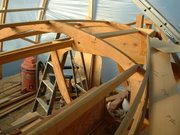
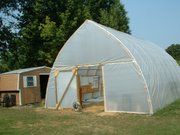
We set up a shed roof over a concrete slab with corrugated fiberglass roof. We had a stack of heavy water proof canvas to close in the open side. The boat had to be built inside so that the wind would not blow away the argon gas that shielded the welding from oxygen in the air.
I took a stack of ½ “ plywood, painted one side putting that side down on the concrete floor hoping it would keep the moisture out so that the plywood would not curl up. The sheets were nailed together with corrugated fasteners the whole thing painted and I started lofting. I had built some smaller boats by eye but had never done any lofting. As a machinist I had done a lot of laying out of machinery and parts. So I started in a way that seem right to me.
Feeling in over my head I visited a local Chesapeake dead rise builder who said, "I don't know nothing about no lofting or working from drawings. I build by proportion and dead reckoning. If it looks right it is and there weren't any measuring or lofting to it. A boat Builder ether know what a boat looks like or he don't, in which case he ain't no boat builder".
Trying a couple of other builders I got some advice that got me going in the right direction. It took me about a week of burning the midnight oil to get her lofted up. Some nights I finished up about one AM.. With a half hour drive home and needing to be back at 7:00 am to run the shop I decided I didn't need to be in such a hurry. After that I cut my days shorter and got more work done and with less mistakes. Before the lofting was complete we began cutting out parts because I had some people with nothing to do.
I did a lot of head scratching laying out the transom but finally got it after some trial and error
We bought a water cooled mig gun for our welder, Rick could weld 60 inches a minute with it continuously. He called it making the fir fly, and he did. I bought a hand held nibbler that could cut the length of aluminum plate in less than a minute.
We straitened up edges with a router and a six foot hardened steel strait edge. For the plating job we used Luann plywood for templates and cut plates to fit with a little sanding here and there. The boat went together in a hurry. We had a boat with bunks and cabinet work ready for sand blasting in eight weeks after the lofting was complete. She had a couple of unfair spots on the hull that we had to cut loose and re weld . On deck there was a spot that kinked because the was a little bit of compound curve there. We used the main hatch slides made ½ in. thick with the proper curve on their bottom edge to pull the kink out. A grab rail was put on to pull out the rest of the kink She looked great from all angles. In addition we placed a set of struts on deck coming from the forward part of the hatch back to the outer edge of the cockpit. It was leaning back about ten degrees. It was there to brace a deck that tended to oil can when walked on. I also figured it might be a good place to snap a dodger on should someone want one.
She was sand blasted the outside one night and the following night we did the interior. The next day we etched with aluminator inside and out and allowed to dry about an hour. With two of us on the outside and two on the inside the whole boat was painted with alodine before she could get a chance to corrode.